

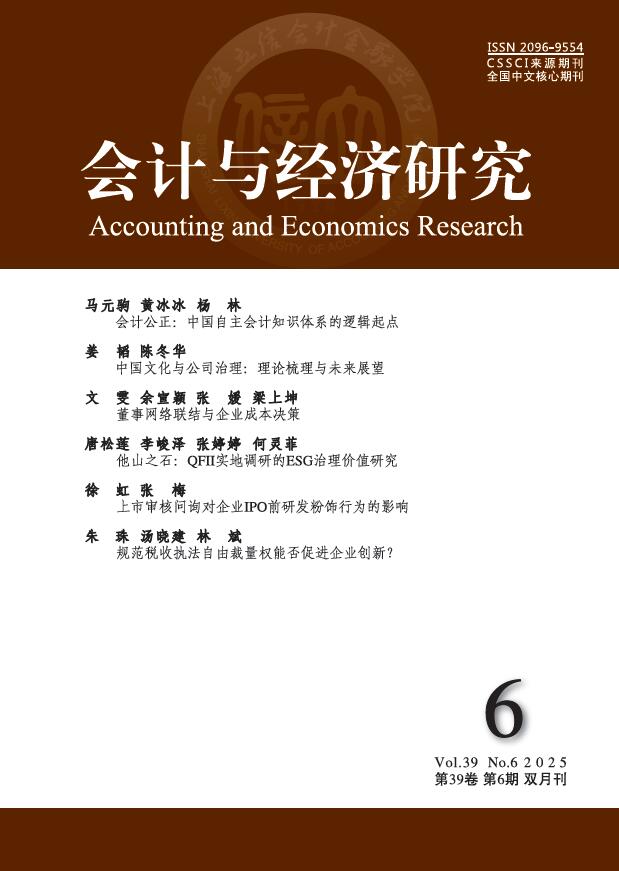

Current Articles
2025, Volume 39, Issue 6
Display Method:
2025,
39(6):
3-19.
Abstract:
The selection of a logical starting point for China’s independent accounting knowledge system is not only a significant theoretical issue in accounting, but also a core concern for the development of accounting practice, and indeed a defining mission for contemporary accounting scholars in the new era. Based on a conceptual review and historical analysis of logical starting points in accounting knowledge systems, this paper examines the essential characteristics such a starting point should possess. It systematically elaborates on the necessity, objectivity, and scientific validity of establishing accounting justice as the foundational premise of China’s independent accounting knowledge system, aiming to provide theoretical support and practical guidance for its construction and development. The findings indicate that: first, accounting justice is well-suited to serve as the logical starting point; second, it embodies key attributes of a logical starting point—primacy, coherence, distinctiveness, historical continuity, contemporary acceptability, and stability; and third, by anchoring the system in accounting justice, we can effectively bridge accounting ethics and accounting theory, reconcile internal contradictions among accounting system components, and enhance both the logical coherence and practical explanatory power of China’s accounting theory system. Moreover, this foundational choice is likely to gain the broadest possible consensus among stakeholders, reinforcing the legitimacy and robustness of the system.
The selection of a logical starting point for China’s independent accounting knowledge system is not only a significant theoretical issue in accounting, but also a core concern for the development of accounting practice, and indeed a defining mission for contemporary accounting scholars in the new era. Based on a conceptual review and historical analysis of logical starting points in accounting knowledge systems, this paper examines the essential characteristics such a starting point should possess. It systematically elaborates on the necessity, objectivity, and scientific validity of establishing accounting justice as the foundational premise of China’s independent accounting knowledge system, aiming to provide theoretical support and practical guidance for its construction and development. The findings indicate that: first, accounting justice is well-suited to serve as the logical starting point; second, it embodies key attributes of a logical starting point—primacy, coherence, distinctiveness, historical continuity, contemporary acceptability, and stability; and third, by anchoring the system in accounting justice, we can effectively bridge accounting ethics and accounting theory, reconcile internal contradictions among accounting system components, and enhance both the logical coherence and practical explanatory power of China’s accounting theory system. Moreover, this foundational choice is likely to gain the broadest possible consensus among stakeholders, reinforcing the legitimacy and robustness of the system.
2025,
39(6):
20-49.
Abstract:
Current research on corporate governance in China remains largely confined to theoretical paradigms rooted in Western culture, with few studies achieving a profound understanding of the essence of Chinese culture. Unless this situation changes, it will be difficult to develop an autonomous knowledge system that is grounded in local contexts and capable of explaining and guiding corporate governance practices in China. Therefore, it is essential to systematically examine the theoretical relationship between Chinese culture and corporate governance and review the trajectory of past research. Accordingly, this article first explores several dimensions of Chinese cultural influence on corporate governance through five perspectives, which include “ethics as the foundation, upholding moral obligations and fulfilling duties” “family, nation, and the world as one, the world as one family” “education through ritual and music, virtue-based governance as the foundation” “inner sage, outer king, restrain oneself and conform to the rites” and “adapting to change, perpetual renewal”. Second, it reviews and evaluates theoretical research on Chinese culture and corporate governance from perspectives including Confucian culture, family culture, personal relationships, and local attachments. Finally, it discusses potential future directions for expanding research on Chinese culture and corporate governance. This article seeks to transcend the limitations of interpreting Chinese concepts through Western frameworks while avoiding the constraints of “Chinese exceptionalism”, aiming to build a bridge for mutual learning between civilizations in corporate governance research between China and the West, thereby contributing to the development of a theoretical system of corporate governance with Chinese characteristics.
Current research on corporate governance in China remains largely confined to theoretical paradigms rooted in Western culture, with few studies achieving a profound understanding of the essence of Chinese culture. Unless this situation changes, it will be difficult to develop an autonomous knowledge system that is grounded in local contexts and capable of explaining and guiding corporate governance practices in China. Therefore, it is essential to systematically examine the theoretical relationship between Chinese culture and corporate governance and review the trajectory of past research. Accordingly, this article first explores several dimensions of Chinese cultural influence on corporate governance through five perspectives, which include “ethics as the foundation, upholding moral obligations and fulfilling duties” “family, nation, and the world as one, the world as one family” “education through ritual and music, virtue-based governance as the foundation” “inner sage, outer king, restrain oneself and conform to the rites” and “adapting to change, perpetual renewal”. Second, it reviews and evaluates theoretical research on Chinese culture and corporate governance from perspectives including Confucian culture, family culture, personal relationships, and local attachments. Finally, it discusses potential future directions for expanding research on Chinese culture and corporate governance. This article seeks to transcend the limitations of interpreting Chinese concepts through Western frameworks while avoiding the constraints of “Chinese exceptionalism”, aiming to build a bridge for mutual learning between civilizations in corporate governance research between China and the West, thereby contributing to the development of a theoretical system of corporate governance with Chinese characteristics.


2025,
39(6):
50-79.
Abstract:
As economic development deepens, cost decisions play an increasingly prominent role in promoting corporate growth and sustaining economic expansion. From a social network perspective, this study examines the impact of director network connections on corporate cost decisions using a sample of Chinese A-share listed firms from 2008 to 2023. The findings reveal that: (1) Overall, increased director network centrality is associated with a significant reduction in corporate cost stickiness. (2) After categorizing cost types, director network connections exhibit a more pronounced inhibitory effect on operating cost stickiness. When distinguishing between director types, the governance role of director network connections is primarily driven by non-independent directors, while the influence of independent directors is relatively limited. (3) Mechanism analysis indicates that director network connections primarily mitigate cost stickiness by strengthening reputation constraints and alleviating industry information asymmetry. (4) Further tests demonstrate that the inhibitory effect is more significant in firms with larger size and higher separation of ownership and control. Additionally, director network connections do not significantly alter the structural uniqueness of corporate costs or revenues but notably enhance cost adjustment elasticity. This study extends the exploration of the determinants of cost stickiness from the perspective of social connections and enriches empirical evidence on the influence of director characteristics on corporate cost decisions.
As economic development deepens, cost decisions play an increasingly prominent role in promoting corporate growth and sustaining economic expansion. From a social network perspective, this study examines the impact of director network connections on corporate cost decisions using a sample of Chinese A-share listed firms from 2008 to 2023. The findings reveal that: (1) Overall, increased director network centrality is associated with a significant reduction in corporate cost stickiness. (2) After categorizing cost types, director network connections exhibit a more pronounced inhibitory effect on operating cost stickiness. When distinguishing between director types, the governance role of director network connections is primarily driven by non-independent directors, while the influence of independent directors is relatively limited. (3) Mechanism analysis indicates that director network connections primarily mitigate cost stickiness by strengthening reputation constraints and alleviating industry information asymmetry. (4) Further tests demonstrate that the inhibitory effect is more significant in firms with larger size and higher separation of ownership and control. Additionally, director network connections do not significantly alter the structural uniqueness of corporate costs or revenues but notably enhance cost adjustment elasticity. This study extends the exploration of the determinants of cost stickiness from the perspective of social connections and enriches empirical evidence on the influence of director characteristics on corporate cost decisions.
2025,
39(6):
80-105.
Abstract:
Promoting foreign investment in alignment with sustainable development is the core essence of China’s high-level opening-up. Using data from Q&A records of site visits on the Shenzhen Stock Exchange’s Interactive Easy platform, this paper selects firms listed on the Shenzhen Stock Exchange from 2012 to 2021 as samples, and examines the impact and mechanisms of QFII site visits on corporate ESG performance. The findings indicate that QFII site visits significantly enhances corporate ESG performance. Mechanism tests reveal that the above effect operates primarily through increasing investor attention and promoting management learning. Heterogeneity analysis shows that the positive effect is more pronounced when QFII originates from regions with higher ESG level and possesses stronger influence, and when firms attract greater analyst coverage and management faces lower short-term ESG pressure. Economic consequence tests demonstrate that QFII site visits could further increase their shareholding once after increasing corporate ESG performance. This paper enriches research on the drivers and mechanisms of corporate ESG performance, expands the theoretical framework of how cross-border capital influences non-financial performance in local enterprises from a behavioral perspective, and provides empirical evidence that high-level opening-up promotes high-quality development in enterprises in China.
Promoting foreign investment in alignment with sustainable development is the core essence of China’s high-level opening-up. Using data from Q&A records of site visits on the Shenzhen Stock Exchange’s Interactive Easy platform, this paper selects firms listed on the Shenzhen Stock Exchange from 2012 to 2021 as samples, and examines the impact and mechanisms of QFII site visits on corporate ESG performance. The findings indicate that QFII site visits significantly enhances corporate ESG performance. Mechanism tests reveal that the above effect operates primarily through increasing investor attention and promoting management learning. Heterogeneity analysis shows that the positive effect is more pronounced when QFII originates from regions with higher ESG level and possesses stronger influence, and when firms attract greater analyst coverage and management faces lower short-term ESG pressure. Economic consequence tests demonstrate that QFII site visits could further increase their shareholding once after increasing corporate ESG performance. This paper enriches research on the drivers and mechanisms of corporate ESG performance, expands the theoretical framework of how cross-border capital influences non-financial performance in local enterprises from a behavioral perspective, and provides empirical evidence that high-level opening-up promotes high-quality development in enterprises in China.

2025,
39(6):
106-132.
Abstract:
With a core focus on sci-tech attributes, the science and technology innovation board (STAR Market) has transformed traditional earnings management under the approval-based system into R&D manipulation targeting innovation capabilities under the registration-based reform. Using a sample of firms listed on the STAR Market between 2019 and 2023, this study examines the governance effect and underlying mechanisms of inquiry-based regulation under the registration-based system on pre-IPO R&D manipulation from the perspective of IPO review inquiry. The findings reveal that high-intensity IPO review inquiry significantly suppresses pre-IPO R&D manipulation, and these conclusions remain robust after addressing endogeneity concerns and conducting rigorous robustness tests. Mechanism analysis indicates that IPO review inquiry primarily mitigates R&D manipulation by enhancing the readability of IPO response letters and strengthening oversight through institutional investor visits. Heterogeneity tests reveal that the suppressive effect is more pronounced in firms with lower corporate governance quality, as well as those audited by high-reputation accounting firms or sponsored by reputable underwriters. Further economic consequence analyses indicate that high-intensity IPO review inquiry effectively reduces IPO overfunding and optimizes capital allocation, whereas pre-IPO R&D manipulation significantly weakens the governance effectiveness of inquiry and exacerbates capital misallocation risks. This study not only uncovers a new trend in IPO opportunism—shifting from earnings manipulation to R&D manipulation under the registration-based system—but also validates the effectiveness of the inquiry system through the chain of regulatory inquiry–disclosure–market monitoring. It provides empirical support for implementing targeted and differentiated review mechanisms on the STAR Market and for reinforcing the gatekeeping responsibilities of intermediary institutions.
With a core focus on sci-tech attributes, the science and technology innovation board (STAR Market) has transformed traditional earnings management under the approval-based system into R&D manipulation targeting innovation capabilities under the registration-based reform. Using a sample of firms listed on the STAR Market between 2019 and 2023, this study examines the governance effect and underlying mechanisms of inquiry-based regulation under the registration-based system on pre-IPO R&D manipulation from the perspective of IPO review inquiry. The findings reveal that high-intensity IPO review inquiry significantly suppresses pre-IPO R&D manipulation, and these conclusions remain robust after addressing endogeneity concerns and conducting rigorous robustness tests. Mechanism analysis indicates that IPO review inquiry primarily mitigates R&D manipulation by enhancing the readability of IPO response letters and strengthening oversight through institutional investor visits. Heterogeneity tests reveal that the suppressive effect is more pronounced in firms with lower corporate governance quality, as well as those audited by high-reputation accounting firms or sponsored by reputable underwriters. Further economic consequence analyses indicate that high-intensity IPO review inquiry effectively reduces IPO overfunding and optimizes capital allocation, whereas pre-IPO R&D manipulation significantly weakens the governance effectiveness of inquiry and exacerbates capital misallocation risks. This study not only uncovers a new trend in IPO opportunism—shifting from earnings manipulation to R&D manipulation under the registration-based system—but also validates the effectiveness of the inquiry system through the chain of regulatory inquiry–disclosure–market monitoring. It provides empirical support for implementing targeted and differentiated review mechanisms on the STAR Market and for reinforcing the gatekeeping responsibilities of intermediary institutions.

2025,
39(6):
133-155.
Abstract:
From the perspective of tax enforcement discretion, this paper selects the gradual implementation of tax enforcement discretion benchmarks across various regions in China starting from 2016 as an exogenous shock, constructing a quasi-natural experiment to examine the impact of standardizing tax enforcement discretion on corporate innovation. The results show that the standardization of tax enforcement discretion significantly promotes corporate innovation, and this positive effect is more pronounced in firms with lower internal control quality and higher levels of collusion between taxpayers and tax authorities. Heterogeneity analysis reveals that the above effect is stronger for firms with higher tax avoidance levels and greater analyst coverage. Economic consequence analysis further shows that the standardization of tax enforcement discretion enhances the firm value of companies with higher innovation levels. These findings extend the existing literature on corporate innovation and tax enforcement, and offer practical implications for improving the quality of corporate innovation decisions.
From the perspective of tax enforcement discretion, this paper selects the gradual implementation of tax enforcement discretion benchmarks across various regions in China starting from 2016 as an exogenous shock, constructing a quasi-natural experiment to examine the impact of standardizing tax enforcement discretion on corporate innovation. The results show that the standardization of tax enforcement discretion significantly promotes corporate innovation, and this positive effect is more pronounced in firms with lower internal control quality and higher levels of collusion between taxpayers and tax authorities. Heterogeneity analysis reveals that the above effect is stronger for firms with higher tax avoidance levels and greater analyst coverage. Economic consequence analysis further shows that the standardization of tax enforcement discretion enhances the firm value of companies with higher innovation levels. These findings extend the existing literature on corporate innovation and tax enforcement, and offer practical implications for improving the quality of corporate innovation decisions.


 Email alert
 RSS
RSS