


2020 Vol. 34, No. 6
Display Method:
2020, 34(6): 3-10.
Abstract:
Data, as a new production element, is the core of digital economy and an important asset of an enterprise. There is little research on accounting theory and practice related to data assets and no relevant accounting standards to define them. This paper studies the meaning and characteristics of data assets, explores the identification, especially the ownership and use right of data assets, discusses measuring methods of data assets, and puts forward suggestions on the report and disclosure of data assets.
Data, as a new production element, is the core of digital economy and an important asset of an enterprise. There is little research on accounting theory and practice related to data assets and no relevant accounting standards to define them. This paper studies the meaning and characteristics of data assets, explores the identification, especially the ownership and use right of data assets, discusses measuring methods of data assets, and puts forward suggestions on the report and disclosure of data assets.
2020, 34(6): 11-31.
Abstract:
China has made remarkable achievements in the construction of internal control standard system. It has achieved comprehensive coverage from enterprises to administrative institutions, and has created the way from learning to innovation. However, the internal control theory represented by COSO is difficult to explain the relationship among organization management, internal control and risk management, leading to the coexistence of internal control standards and risk management standards. The consequence of difficulty of integrating internal control into organizational management is that the construction of internal control becomes a mere formality. Hence, it is necessary to coordinate internal control, risk management, corporate governance, financial management and management accounting standards from the perspective of management and control integration, establish the internal control standard system in a new era to meet the needs of national informatization development strategy, and realize the overall innovation of internal control standard system.
China has made remarkable achievements in the construction of internal control standard system. It has achieved comprehensive coverage from enterprises to administrative institutions, and has created the way from learning to innovation. However, the internal control theory represented by COSO is difficult to explain the relationship among organization management, internal control and risk management, leading to the coexistence of internal control standards and risk management standards. The consequence of difficulty of integrating internal control into organizational management is that the construction of internal control becomes a mere formality. Hence, it is necessary to coordinate internal control, risk management, corporate governance, financial management and management accounting standards from the perspective of management and control integration, establish the internal control standard system in a new era to meet the needs of national informatization development strategy, and realize the overall innovation of internal control standard system.
2020, 34(6): 32-44.
Abstract:
This article uses the data of China’s A-share listed companies from 2010 to 2018 to examine the impact of horizontal and vertical expansion on internal control deficiencies, and explores the influence intensity in different institutional environments. The result shows that with the increase in integration level, vertical integration exacerbates internal control deficiencies, while horizontal integration suppresses internal control deficiencies. Both relationships are stronger in a better institutional environment. With further study on equity heterogeneity and debt heterogeneity, it is found that when the degree of separation of the two rights is lower, vertical integration will aggravate internal control deficiencies more significantly; when equity concentration is lower and debt heterogeneity is stronger, the impact of vertical integration’s aggravation and horizontal integration’s suppression on internal control deficiencies will be strengthened.
This article uses the data of China’s A-share listed companies from 2010 to 2018 to examine the impact of horizontal and vertical expansion on internal control deficiencies, and explores the influence intensity in different institutional environments. The result shows that with the increase in integration level, vertical integration exacerbates internal control deficiencies, while horizontal integration suppresses internal control deficiencies. Both relationships are stronger in a better institutional environment. With further study on equity heterogeneity and debt heterogeneity, it is found that when the degree of separation of the two rights is lower, vertical integration will aggravate internal control deficiencies more significantly; when equity concentration is lower and debt heterogeneity is stronger, the impact of vertical integration’s aggravation and horizontal integration’s suppression on internal control deficiencies will be strengthened.
2020, 34(6): 45-59.
Abstract:
Based on the exogenous event in China’s security market implementing margin trading system, this paper examines the effect of the short selling mechanism on corporate charitable donations. The result shows that the short selling mechanism helps negative news integrated into stock prices in a timely manner, thus the company has incentives to improve the level of charitable donations to mitigate the impact of negative news in the face of falling stock pressure. Further research shows that with invisible guarantees provided by the government, state-owned companies have the weak motivation to mitigate negative news shocks through charitable donations. While, non-state-owned companies own relatively greater autonomy in decision-making of charitable donations. Therefore, compared with state-owned companies, the short selling mechanism has significantly improved the level of charitable donations from non-state-owned companies. Moreover, if the controlling shareholder pledges equity, the company has stronger incentive to prevent the company’s stock price from falling, the short selling mechanism has more significant effects on the level improvement of charitable donations.
Based on the exogenous event in China’s security market implementing margin trading system, this paper examines the effect of the short selling mechanism on corporate charitable donations. The result shows that the short selling mechanism helps negative news integrated into stock prices in a timely manner, thus the company has incentives to improve the level of charitable donations to mitigate the impact of negative news in the face of falling stock pressure. Further research shows that with invisible guarantees provided by the government, state-owned companies have the weak motivation to mitigate negative news shocks through charitable donations. While, non-state-owned companies own relatively greater autonomy in decision-making of charitable donations. Therefore, compared with state-owned companies, the short selling mechanism has significantly improved the level of charitable donations from non-state-owned companies. Moreover, if the controlling shareholder pledges equity, the company has stronger incentive to prevent the company’s stock price from falling, the short selling mechanism has more significant effects on the level improvement of charitable donations.
2020, 34(6): 60-75.
Abstract:
Zhisui is a special position in ancient temples, which is often seen in Dunhuang manuscripts and attracts lots of attention. Opinions vary as to what exactly Zhisui is in charge of and whether it is a temple accountant. Following this, it involves whether there is a full-time accountant in temple management, and the system and status of temple financial management. These questions actually affect the overall judgment on the organization and work status of ancient non-government accounting system in China, and then have a historical significance. Relying on original materials found in Dunhuang documents combined with the analysis of Conglin Rules in Song and Yuan dynasties, this paper finds that the Zhisui is not an accountant of temple, but a staff with rotating nature. Temples in Song and Yuan dynasties, as an organization with a dual characteristic of religion and economy, had made great progress in accounting system with their increasingly developed business. Although there is no dedicated accounting institution, it has been promoted from the head of warehouse in charge of storage management to the deputy director of temple with more holistic significance. The system of accounting report, verification and internal division of labor is more completed.
Zhisui is a special position in ancient temples, which is often seen in Dunhuang manuscripts and attracts lots of attention. Opinions vary as to what exactly Zhisui is in charge of and whether it is a temple accountant. Following this, it involves whether there is a full-time accountant in temple management, and the system and status of temple financial management. These questions actually affect the overall judgment on the organization and work status of ancient non-government accounting system in China, and then have a historical significance. Relying on original materials found in Dunhuang documents combined with the analysis of Conglin Rules in Song and Yuan dynasties, this paper finds that the Zhisui is not an accountant of temple, but a staff with rotating nature. Temples in Song and Yuan dynasties, as an organization with a dual characteristic of religion and economy, had made great progress in accounting system with their increasingly developed business. Although there is no dedicated accounting institution, it has been promoted from the head of warehouse in charge of storage management to the deputy director of temple with more holistic significance. The system of accounting report, verification and internal division of labor is more completed.

2020, 34(6): 76-93.
Abstract:
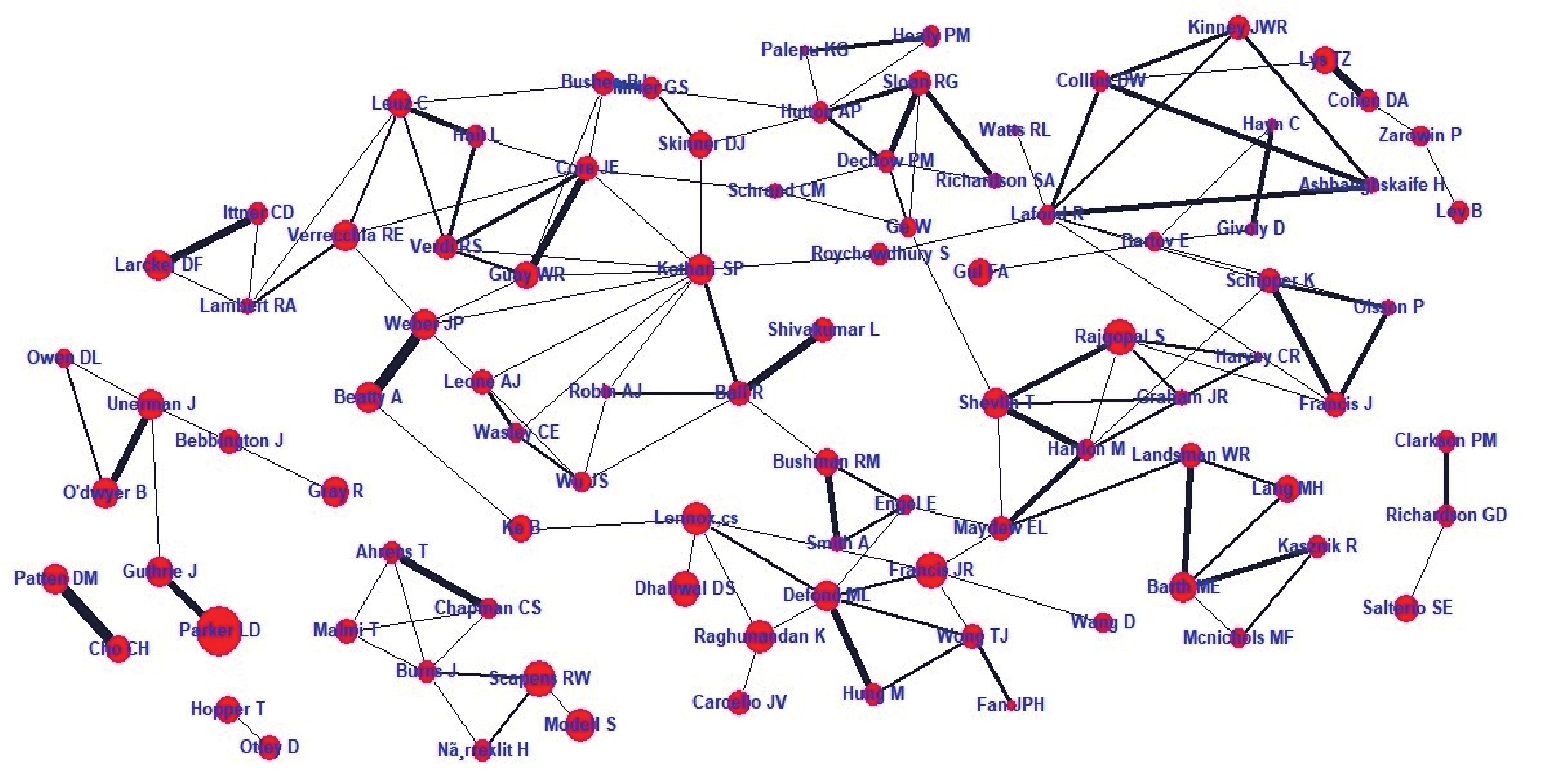
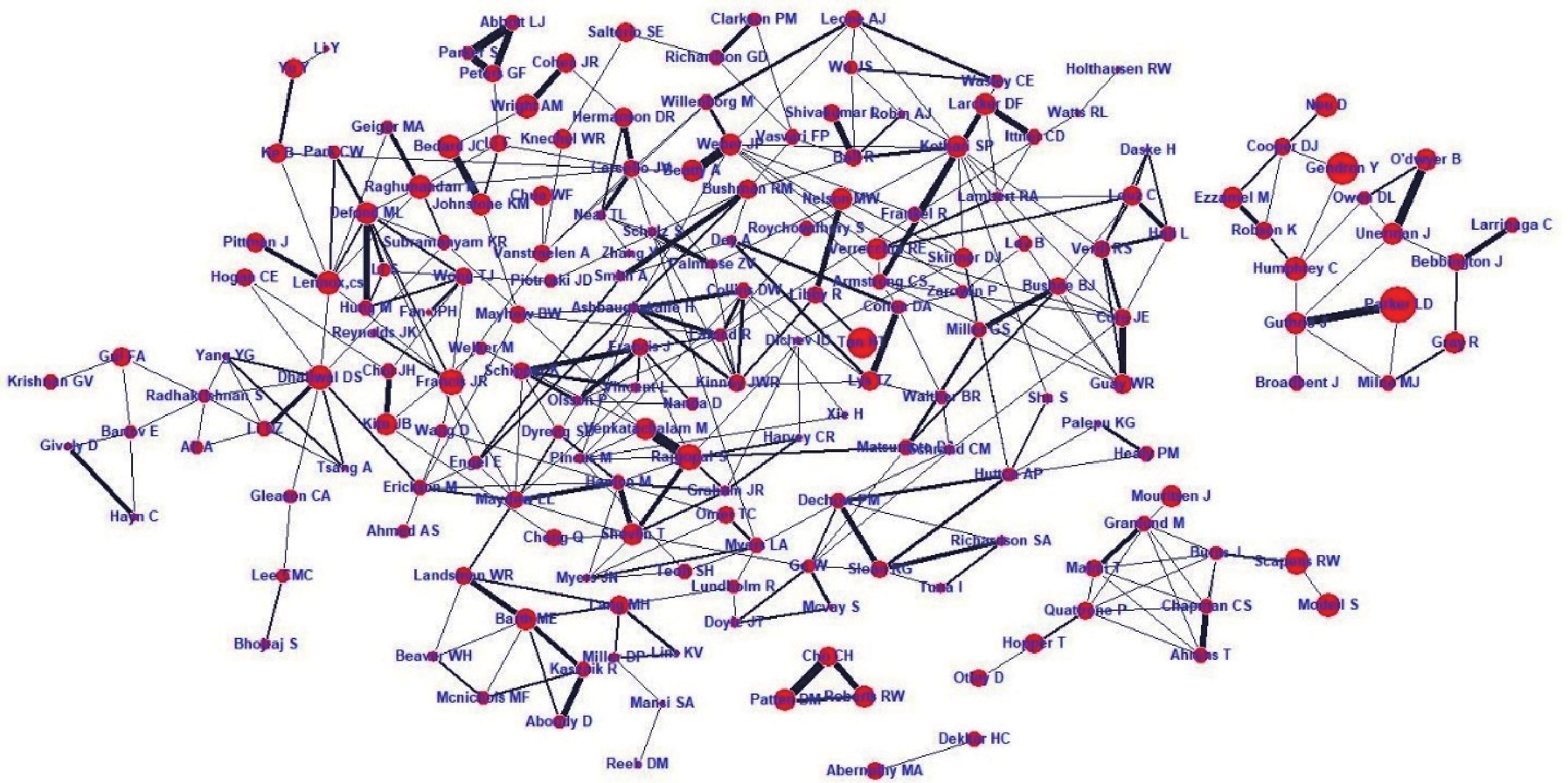
This paper uses the Scopus database as a data-source, selects 12 Q1 international accounting journals according to the discipline ranking in 2018, and collects 7,123 journal articles published from 1999 to 2018. The research collaboration in accounting is analyzed in two perspectives. Firstly, regression analysis is used to study the impact of research collaboration on the quality of papers. It is found that author collaboration and the collaboration between authors from different institutions and countries can significantly improve the quality of papers. Secondly, the social network analysis method is used to analyze the author’s collaboration network in the accounting field, and it is found that the collaboration network has a large proportion of main groups, a high clustering coefficient, and a low average network distance, indicating that the author’s collaboration network in accounting field is characteristic of Small World. Further analysis on the collaboration network of the top 100 and top 200 authors with high citation rates finds that there is a close relationship among core authors. The research highlights the impact of collaboration on the quality of scientific research, and provides a reference for researchers in the accounting field to examine the collaboration networking, strengthen collaboration with core authors with great influence through various channels, and improve the quality of scientific research.
This paper uses the Scopus database as a data-source, selects 12 Q1 international accounting journals according to the discipline ranking in 2018, and collects 7,123 journal articles published from 1999 to 2018. The research collaboration in accounting is analyzed in two perspectives. Firstly, regression analysis is used to study the impact of research collaboration on the quality of papers. It is found that author collaboration and the collaboration between authors from different institutions and countries can significantly improve the quality of papers. Secondly, the social network analysis method is used to analyze the author’s collaboration network in the accounting field, and it is found that the collaboration network has a large proportion of main groups, a high clustering coefficient, and a low average network distance, indicating that the author’s collaboration network in accounting field is characteristic of Small World. Further analysis on the collaboration network of the top 100 and top 200 authors with high citation rates finds that there is a close relationship among core authors. The research highlights the impact of collaboration on the quality of scientific research, and provides a reference for researchers in the accounting field to examine the collaboration networking, strengthen collaboration with core authors with great influence through various channels, and improve the quality of scientific research.
2020, 34(6): 94-111.
Abstract:
Financial security is an important foundation for the steady and healthy development of the economy, and preventing and deflating systemic risks is the fundamental task of financial work. Based on the relevant data of 16 listed banks and manufacturing industries in China from 2008 to 2018, this paper conducts an empirical analysis on the relationship among manufacturing leverage, corporate heterogeneity and banking systemic risk. The results show that: First, manufacturing leverage has a significantly positive impact on bank systemic risks, but the transmission mechanism is not single and complex. Second, there is obvious corporate heterogeneity in the impact of manufacturing leverage on bank systemic risk, which is mainly manifested in a large difference in the way and transmission path of the overall leverage ratio of state-owned enterprises and private enterprises on bank systemic risk. Third, the bank liquidity supervision indicators alleviate the adverse impact of manufacturing leverage on bank systemic risks to a certain extent, and this mitigation effect is mainly manifested in state-owned enterprises. To this end, we should strengthen the source governance of bank systemic risks, promote manufacturing enterprises to reduce debt leverage, and promote the orderly and appropriate transfer of debt leverage from non-financial corporate sectors to government and residential sectors, so as to better achieve overall manufacturing transformation and upgrading and the healthy and stable development of the financial system.
Financial security is an important foundation for the steady and healthy development of the economy, and preventing and deflating systemic risks is the fundamental task of financial work. Based on the relevant data of 16 listed banks and manufacturing industries in China from 2008 to 2018, this paper conducts an empirical analysis on the relationship among manufacturing leverage, corporate heterogeneity and banking systemic risk. The results show that: First, manufacturing leverage has a significantly positive impact on bank systemic risks, but the transmission mechanism is not single and complex. Second, there is obvious corporate heterogeneity in the impact of manufacturing leverage on bank systemic risk, which is mainly manifested in a large difference in the way and transmission path of the overall leverage ratio of state-owned enterprises and private enterprises on bank systemic risk. Third, the bank liquidity supervision indicators alleviate the adverse impact of manufacturing leverage on bank systemic risks to a certain extent, and this mitigation effect is mainly manifested in state-owned enterprises. To this end, we should strengthen the source governance of bank systemic risks, promote manufacturing enterprises to reduce debt leverage, and promote the orderly and appropriate transfer of debt leverage from non-financial corporate sectors to government and residential sectors, so as to better achieve overall manufacturing transformation and upgrading and the healthy and stable development of the financial system.

2020, 34(6): 112-126.
Abstract:
This paper takes China’s listed financial institutions as research samples, and uses financial market transaction data and the multi-GARCH model to study whether there is a conflict of interest between shareholders and creditors of financial institutions under the premise of controlling the risk status of financial institutions. The empirical analysis shows that in a high-risk state, most shareholders and creditors of financial institution can work together, especially when the risk exceeds a threshold, shareholders and creditors of financial institution have the motivation to cooperate with each other to overcome difficulties and maximize the common good. At the same time, the empirical analysis also indicates that shareholders and creditors of 24 financial institutions in sample do not show the spirit of “sharing suffering” in the high-risk state. Then, the relationship between shareholders and creditors of financial institutions are characteristic of heterogeneity in the high-risk state. While in a low-risk state, there is a buffer area for rising risks. Shareholders will use this space to increase the corporate operating risks, which will cause creditors to worry about future risks, and hence increase the bond discount rate, decrease the bond value, the conflict of interest between shareholders and creditors turns more significant. In general, the empirical conclusion shows that there is a greater possibility of conflicts of interest between shareholders and creditors of financial institution.
This paper takes China’s listed financial institutions as research samples, and uses financial market transaction data and the multi-GARCH model to study whether there is a conflict of interest between shareholders and creditors of financial institutions under the premise of controlling the risk status of financial institutions. The empirical analysis shows that in a high-risk state, most shareholders and creditors of financial institution can work together, especially when the risk exceeds a threshold, shareholders and creditors of financial institution have the motivation to cooperate with each other to overcome difficulties and maximize the common good. At the same time, the empirical analysis also indicates that shareholders and creditors of 24 financial institutions in sample do not show the spirit of “sharing suffering” in the high-risk state. Then, the relationship between shareholders and creditors of financial institutions are characteristic of heterogeneity in the high-risk state. While in a low-risk state, there is a buffer area for rising risks. Shareholders will use this space to increase the corporate operating risks, which will cause creditors to worry about future risks, and hence increase the bond discount rate, decrease the bond value, the conflict of interest between shareholders and creditors turns more significant. In general, the empirical conclusion shows that there is a greater possibility of conflicts of interest between shareholders and creditors of financial institution.

 Email alert
 RSS