
Host: Shanghai Lixin University of Accounting and Finance

Host: 上海立信会计金融学院
- ISSN 2096-9554
- CN 31-2074/F
Host: Shanghai Lixin University of Accounting and Finance
Host: 上海立信会计金融学院
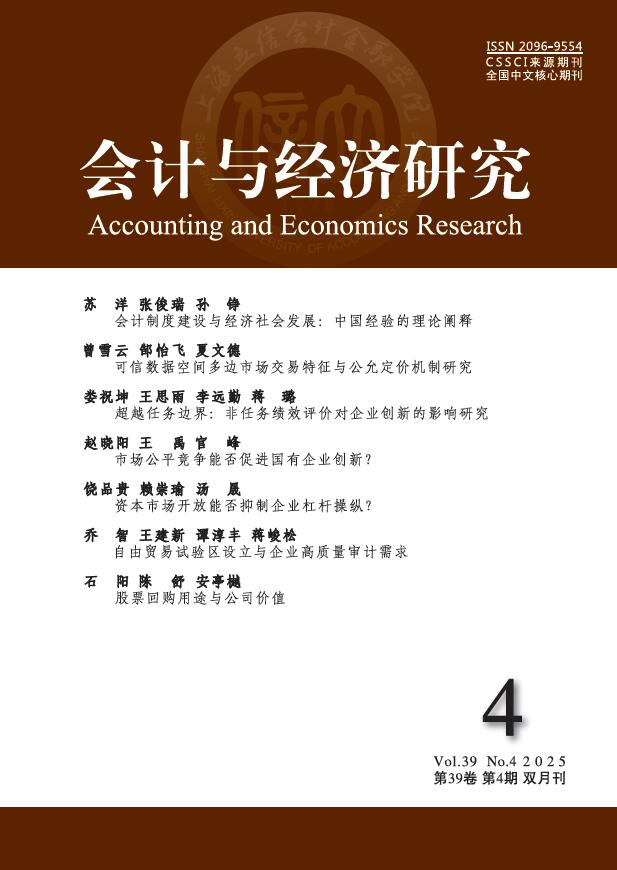
| Citation: | Lou Zhukun, Wang Siyu, Li Yuanqin, Jiang Lu. 2025. Beyond Task Boundaries: The Impact of Non-task Performance Evaluation on Corporate Innovation. Accounting and Economic Research, 39(4): 50-73.

|

| [1] |
高晨. 2008. 主观业绩评价研究: 述评与启示. 会计研究 (4): 84−88.
|
| [2] |
高晨, 汤谷良. 2009. 主观业绩评价、高管激励与制度效果——基于我国企业高管评价的多案例研究. 中国工业经济 (4): 147−156.
|
| [3] |
蒋春燕. 2007. 员工公平感与组织承诺和离职倾向之间的关系: 组织支持感中介作用的实证研究. 经济科学 (6): 118−128.
|
| [4] |
李鑫, 黄亮. 2024. 员工创造力效应的研究述评. 管理现代化 (6): 187−200.
|
| [5] |
柳卸林, 高雨辰, 丁雪辰. 2017. 寻找创新驱动发展的新理论思维——基于新熊彼特增长理论的思考. 管理世界 (12): 8−19.
|
| [6] |
娄祝坤, 毛瑾晔. 2023. 创新型企业业绩评价系统设计: 理论框架. 财会月刊 (3): 24−31.
|
| [7] |
娄祝坤, 张川, 刘雅欣. 2023. 从“知之者”到“乐之者”: 非任务绩效评价对员工自主动机的激励效应研究. 会计研究 (7): 118−131.
|
| [8] |
潘飞, 魏春燕. 2021. 管理会计实地研究述评: 比较与借鉴. 会计研究 (1): 132−144.
|
| [9] |
王化成, 刘俊勇. 2004. 企业业绩评价模式研究——兼论中国企业业绩评价模式选择. 管理世界 (4): 82−91, 116.
|
| [10] |
吴迪, 张玉昌. 2019. 企业创新过程中独立董事真的是“签字工具”吗? ——基于中国企业数据的效应与机制分析. 产业经济研究 (5): 89−102.
|
| [11] |
吴培冠, 陈婷婷. 2009. 绩效管理的取向对团队绩效影响的实证研究. 南开管理评论 (6): 51−59, 76.
|
| [12] |
闫伟宸, 高思悦. 2022. 高管团队的社会关系与企业创新——基于“本家关系”的视角. 会计研究 (2): 70−85.
|
| [13] |
杨金玉, 罗勇根, 陈世强. 2023. 团队稳定性是否提高了企业二元创新? ——基于研发人员合作关系的实证研究. 科学学与科学技术管理 (4): 82−101.
|
| [14] |
杨玉龙, 潘飞, 张川. 2014. 差序格局视角下的中国企业业绩评价. 会计研究 (10): 66−73.
|
| [15] |
张守文, 汤谷良. 2019. 企业主观业绩评价的理论主张与实施要领. 中国管理会计 (4): 5−18.
|
| [16] |
张秀娥, 周荣鑫, 王于佳. 2012. 创业团队成员信任对社会网络与企业创新能力关系的影响. 经济与管理研究 (3): 105−111.
|
| [17] |
Aiswarya, B., and G. Ramasundaram. 2014. Job autonomy and job involvement as a cause for turnover intention of the women employees with job satisfaction as a moderator. Management Today 4(2): 13−18. doi: 10.11127/gmt.2014.06.03
|
| [18] |
Amabile, T. M., R. Conti, and H. Coon. 1996. Assessing the work environment for creativity. Academy of Management Journal 39(5): 1154−1184. doi: 10.2307/256995
|
| [19] |
Anderson, S. W., H. C. Dekker, and K. L. Sedatole. 2020. When one size does not fit all: Using ex post subjective ratings to provide parity in risk-adjusted compensation. Management Accounting Research 49, 100706. doi: 10.1016/j.mar.2020.100706
|
| [20] |
Anderson, T., and M. R. Haas. 2020. Employee inter-and intra-firm mobility: Taking stock of what we know, identifying novel insights and setting a theoretical and empirical agenda. Bingley: Emerald Publishing Limited.
|
| [21] |
Baker, W. E., and J. M. Sinkula. 2002. Market orientation, learning orientation and product innovation: Delving into the organization’s black box. Journal of Market-Focused Management 5: 5−23.
|
| [22] |
Balkin, D. B., G. D. Markman, and L. R. Gomez-Mejia. 2000. Is CEO pay in high-technology firms related to innovation? Academy of Management Journal 46(6): 1118−1129.
|
| [23] |
Banker, R. D., G. Potter, and D. Srinivasan. 2000. An empirical investigation of an incentive plan that includes nonfinancial performance measures. The Accounting Review 75(1): 65−92. doi: 10.2308/accr.2000.75.1.65
|
| [24] |
Banker, R. D., H. Chang, and M. J. Pizzini. 2004. The balanced scorecard: Judgmental effects of performance measures linked to strategy. The Accounting Review 79(1): 1−23. doi: 10.2308/accr.2004.79.1.1
|
| [25] |
Barney, J. 1991. Firm resources and sustained competitive advantage. Journal of Management 17(1): 99−120. doi: 10.1177/014920639101700108
|
| [26] |
Bedford, D. S. 2015. Management control systems across different modes of innovation: Implications for firm performance. Management Accounting Research 28: 12−30. doi: 10.1016/j.mar.2015.04.003
|
| [27] |
Bisbe, J., and D. Otley. 2004. The effects of the interactive use of management control systems on product innovation. Accounting, Organizations and Society 29(8): 709−737. doi: 10.1016/j.aos.2003.10.010
|
| [28] |
Bonner, S. E., and G. B. Sprinkle. 2002. The effects of monetary incentives on effort and task performance: Theories, evidence, and a framework for research. Accounting, Organizations and Society 27(4-5): 303−345. doi: 10.1016/S0361-3682(01)00052-6
|
| [29] |
Brown, S. L., and K. M. Eisenhardt. 1995. Product development: Past research, present findings, and future directions. Academy of Management Review 20(2): 343−378. doi: 10.2307/258850
|
| [30] |
Camisón, C., and A. Villar-López. 2014. Organizational innovation as an enabler of technological innovation capabilities and firm performance. Journal of Business Research 67(1): 2891−2902. doi: 10.1016/j.jbusres.2012.06.004
|
| [31] |
Cardinaels, E., and C. Feichter. 2021. Forced rating systems from employee and supervisor perspectives. Journal of Accounting Research 59(5): 1573−1607. doi: 10.1111/1475-679X.12388
|
| [32] |
Chen, C. X., J. B. Lill, and T. W. Vance. 2020. Management control system design and employees’ autonomous motivation. Journal of Management Accounting Research 32(3): 71−91. doi: 10.2308/jmar-17-068
|
| [33] |
Cheng, M. M., and R. Coyte. 2014. The effects of incentive subjectivity and strategy communication on knowledge-sharing and extra-role behaviours. Management Accounting Research 25(2): 119−130. doi: 10.1016/j.mar.2013.07.003
|
| [34] |
Christ, M. H., S. A. Emett, W. B. Tayler, and D. A. Wood. 2016. Compensation or feedback: Motivating performance in multidimensional tasks. Accounting, Organizations and Society 50: 27−40. doi: 10.1016/j.aos.2016.03.003
|
| [35] |
Dai, N. T., X. Kuang, and G. Tang. 2016. Differential weighting of objective versus subjective measures in performance evaluation: Experimental evidence. European Accounting Review 27(1): 129−148.
|
| [36] |
Damanpour, F., K. A. Szabat, and W. M. Evan. 1989. The relationship between types of innovation and organizational performance. Journal of Management Studies 26(6): 587−602. doi: 10.1111/j.1467-6486.1989.tb00746.x
|
| [37] |
Deci, E. L., and R. M. Ryan. 1985. The general causality orientations scale: Self-determination in personality. Journal of Research in Personality 19(2): 109−134. doi: 10.1016/0092-6566(85)90023-6
|
| [38] |
Franco-Santos, M., L. Lucianetti, and M. Bourne. 2012. Contemporary performance measurement systems: A review of their consequences and a framework for research. Management Accounting Research 23(2): 79−119.
|
| [39] |
Gibbs, M., K. A. Merchant, W. A. Van der Stede, and M. E. Vargus. 2004. Determinants and effects of subjectivity in incentives. The Accounting Review 79(2): 409−436. doi: 10.2308/accr.2004.79.2.409
|
| [40] |
Golman, R., and S. Bhatia. 2012. Performance evaluation inflation and compression. Accounting, Organizations and Society 37(8): 534−543. doi: 10.1016/j.aos.2012.09.001
|
| [41] |
Grabner, I. 2014. Incentive system design in creativity-dependent firms. The Accounting Review 89(5): 1729−1750. doi: 10.2308/accr-50756
|
| [42] |
Grabner, I., and G. Speckbacher. 2016. The cost of creativity: A control perspective. Accounting, Organizations and Society 48: 31−42. doi: 10.1016/j.aos.2015.11.001
|
| [43] |
Grant, A. M. 2008. The significance of task significance: Job performance effects, relational mechanisms, and boundary conditions. Journal of Applied Psychology 93(1): 108−124. doi: 10.1037/0021-9010.93.1.108
|
| [44] |
Hecht, G., J. L. Hobson, and L. W. Wang. 2020. The effect of performance reporting frequency on employee performance. The Accounting Review 95(4): 199−218. doi: 10.2308/accr-52601
|
| [45] |
Henri, J. F., and M. Wouters. 2020. Interdependence of management control practices for product innovation: The influence of environmental unpredictability. Accounting, Organizations and Society 86, 101073. doi: 10.1016/j.aos.2019.101073
|
| [46] |
Holmstrom, B. 1989. Agency costs and innovation. Journal of Economic Behavior & Organization 12(3): 305−327.
|
| [47] |
Ittner, C. D., D. F. Larcker, and M. V. Rajan. 1997. The choice of performance measures in annual bonus contracts. The Accounting Review 72(2): 231−255.
|
| [48] |
Kalmuk, G., and A. Z. Acar. 2015. The mediating role of organizational learning capability on the relationship between innovation and firm’s performance: A conceptual framework. Procedia-Social and Behavioral Sciences 210: 164−169. doi: 10.1016/j.sbspro.2015.11.355
|
| [49] |
Kankanhalli, A., B. C. Y. Tan, and K. K. Wei. 2005. Contributing knowledge to electronic knowledge repositories: An empirical investigation. MIS Quarterly 29(1): 113−143. doi: 10.2307/25148670
|
| [50] |
Kaplan, R. S., and D. P. Norton. 2001. Transforming the balanced scorecard from performance measurement to strategic management: Part 1. Accounting Horizons 15(1): 87−104. doi: 10.2308/acch.2001.15.1.87
|
| [51] |
Klein, A., and G. Speckbacher. 2020. Does using accounting data in performance evaluations spoil team creativity? The role of leadership behavior. The Accounting Review 95(4): 313−330. doi: 10.2308/accr-52602
|
| [52] |
Kunz, J. 2015. Objectivity and subjectivity in performance evaluation and autonomous motivation: An exploratory study. Management Accounting Research 27: 27−46.
|
| [53] |
Lillis, A. M., M. A. Malina, and J. Mundy. 2022. The role of subjectivity in mitigating incentive contracting risks. The Accounting Review 97(1): 365−388. doi: 10.2308/TAR-2017-0652
|
| [54] |
Liu, D., X. P. Chen, and X. Yao. 2011. From autonomy to creativity: A multilevel investigation of the mediating role of harmonious passion. Journal of Applied Psychology 96(2): 294−309. doi: 10.1037/a0021294
|
| [55] |
Liu, D., Y. Gong, J. Zhou, and J. C. Huang. 2017. Human resource systems, employee creativity, and firm innovation: The moderating role of firm ownership. Academy of Management Journal 60(3): 1164−1188. doi: 10.5465/amj.2015.0230
|
| [56] |
March, J. G. 1991. Exploration and exploitation in organizational learning. Organization Science 2(1): 71−87. doi: 10.1287/orsc.2.1.71
|
| [57] |
McEvily, B., V. Perrone, and A. Zaheer. 2003. Trust as an organizing principle. Organization Science 14(1): 91−103. doi: 10.1287/orsc.14.1.91.12814
|
| [58] |
Merchant, K. A., W. A. Van der Stede, and L. Zheng. 2003. Disciplinary constraints on the advancement of knowledge: The case of organizational incentive systems. Accounting, Organizations and Society 28(2-3): 251−286. doi: 10.1016/S0361-3682(01)00051-4
|
| [59] |
Moers, F. 2005. Discretion and bias in performance evaluation: The impact of diversity and subjectivity. Accounting, Organizations and Society 30(1): 67−80. doi: 10.1016/j.aos.2003.11.001
|
| [60] |
Moers, F. 2006. Performance measure properties and delegation. The Accounting Review 81(4): 897−924. doi: 10.2308/accr.2006.81.4.897
|
| [61] |
Nonaka, I. 1994. A dynamic theory of organizational knowledge creation. Organization Science 5(1): 14−37. doi: 10.1287/orsc.5.1.14
|
| [62] |
Oldham, G. R. 2003. Stimulating and supporting creativity in organizations. Managing knowledge for sustained competitive advantage: Designing strategies for effective human resource management. San Francisco: Jossey-Bass.
|
| [63] |
O’Reilly, C. A., J. A. Chatman, and D. F. Caldwell. 1991. People and organizational culture: A profile comparison approach to assessing person-organization fit. Academy of Management Journal 34(3): 487−516. doi: 10.2307/256404
|
| [64] |
Organ, D. W. 1977. A reappraisal and reinterpretation of the satisfaction-causes-performance hypothesis. Academy of Management Review 2(1): 46−53.
|
| [65] |
Owhorji, S., and P. O. Olomi. 2023. Employee creativity and competitive advantage of hotels in Port Harcourt, Rivers State, Nigeria. Nigerian Journal of Management Sciences 24(2b): 215−221.
|
| [66] |
Perry-Smith, J. E., and C. E. Shalley. 2003. The social side of creativity: A static and dynamic social network perspective. Academy of Management Review 28(1): 89−106. doi: 10.2307/30040691
|
| [67] |
Petersen, M. J. 2007. Using downstream revenue in a performance measurement system. Contemporary Accounting Research (4): 1193−1215.
|
| [68] |
Prendergast, C. 2008. Intrinsic motivation and incentives. American Economic Review 98(2): 201−205. doi: 10.1257/aer.98.2.201
|
| [69] |
Ryan, R. M., and E. L. Deci. 2000. Self-determination theory and the facilitation of intrinsic motivation, social development, and well-being. American Psychologist 55(1): 68−78. doi: 10.1037/0003-066X.55.1.68
|
| [70] |
Thornhill, S. 2006. Knowledge, innovation and firm performance in high-and low-technology regimes. Journal of Business Venturing 21(5): 687−703. doi: 10.1016/j.jbusvent.2005.06.001
|
| [71] |
Tu, Y. D., and X. X. Lu. 2013. How ethical leadership influence employees’ innovative work behavior: A perspective of intrinsic motivation. Journal of Business Ethics 116(2): 441−455.
|
| [72] |
Van der Hauwaert, E., S. Hoozée, S. Maussen, and W. Bruggeman. 2022. The impact of enabling performance measurement on managers’ autonomous work motivation and performance. Management Accounting Research 55, 100780. doi: 10.1016/j.mar.2021.100780
|
| [73] |
Van der Stede, W. A., C. W. Chow, and T. W. Lin. 2006. Strategy, choice of performance measures, and performance. Behavioral Research in Accounting 18(1): 185−205. doi: 10.2308/bria.2006.18.1.185
|
| [74] |
Webb, R. A., M. G. Williamson, and Y. M. Zhang. 2013. Productivity-target difficulty, target-based pay, and outside-the-box thinking. The Accounting Review 88(4): 1433−1457. doi: 10.2308/accr-50436
|
| [75] |
Woods, A. 2012. Subjective adjustments to objective performance measures: The influence of prior performance. Accounting, Organizations and Society 37(6): 403−425. doi: 10.1016/j.aos.2012.06.001
|
| [76] |
Zhang, Y., L. Long, T. Y. Wu, and X. Huang. 2015. When is pay for performance related to employee creativity in the Chinese context? The role of guanxi HRM practice, trust in management, and intrinsic motivation. Journal of Organizational Behavior 36(5): 698−719. doi: 10.1002/job.2012
|

 DownLoad: